Why Big History?
Byadmin
VIDEOS
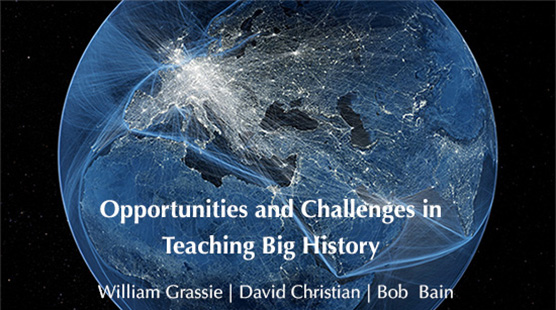
William Grassie, Big History: The New Narrative, 8:37
David Christian, The What and Why of Big History, 21:53.
Bob Bain, Big Questions about Big History in US schools, 42:09.

VIDEOS
William Grassie, Big History: The New Narrative, 8:37
David Christian, The What and Why of Big History, 21:53.
Bob Bain, Big Questions about Big History in US schools, 42:09.

Applied Big History: A Guide for Entrepreneurs, Investors, and Other Living Things With a Foreword by Mitch Julis Cover Photo Credit: NASA Earth Observatory images by Joshua Stevens, using Suomi NPP VIIRS data from Miguel Román, NASA’s Goddard Space Flight Center Table of Contents Foreword by Mitch Julis, Canyon Partners 1. Thriving in a Complex…
Environmentalists might applaud a planet at the turn of the next century with 2 billion fewer people than today. The economic consequences, however, could be catastrophic.
We need to humbly put questions about the universe and the universal back at the heart of education, including and especially religious education.
Big History seeks to evoke in you an appreciation for the immensity of science and a longing for the greatest story ever told.
A review of Ecological Developmental Biology: Integrating Epigenetics, Medicine, and Evolution, By Scott F. Gilbert and David Epel (Sunderland, MA: Sinauer 2009). As a combatant in the evolution wars here in the United States and abroad, I have penned and processed quite a few papers on the interpretation of evolution.1 This means also reviewing the…
“We are the music makers,And we are the dreamers of dreams…” “Each age is a dream that is dying,Or one that is coming to birth.” Arthur O’Shaughnessy, in his great Ode, captured something uncannily like our moment: history does not move only through institutions, arguments, and systems. It also moves through imagination, desire, vision, and world-making….