Technological Mandalas

Artist’s Statement

I am interested in how systems can be applied in the process of making art, how something can survive within a scheme of convention, exploring the system itself in order to understand it, and perhaps, trying to find a condition of artistic autonomy within the framework I create. Like Mondrian’s grids, the abstraction in my work has to survive, and find a place within a defined structure. My modus operandi embraces my passions for electronics, music, science, and graphic design.

I like to define myself as a multimedia artist and my art works as playthings. As with childhood toys, art objects can be seen as many distorted reflections of the everyday, caricatures of the real. These do not need to be pleasant-looking or easy-to-use but have to possess, above all, a high degree of play value, which is what defines the capacity of a toy/ artifact to stimulate and engage the viewer. This moves the attention of the spectator into places they probably know, but have forgotten, pitting the unconscious against the rational and vice-versa.

Technological Mandala Series

I am intrigued by the fact that electronic technology has become an important part in our daily life, almost something to worship. 

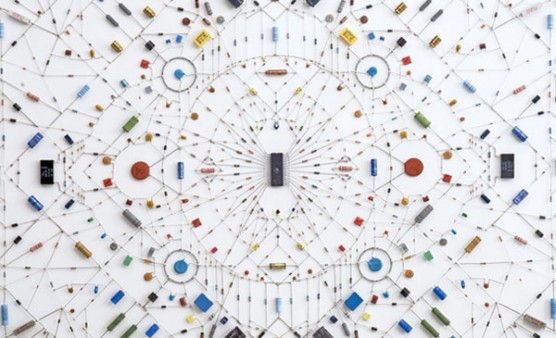
With the Technological Mandala Series, I am showing what is hidden from the eyes of the consumer, representing technology and, in particular, electronic circuits as extraordinary objects, where the perfection of the design can become almost something ethereal. 
In reality my Technological Mandalas do not work as traditional electronics circuits, but I see them as ephemeral gizmos able to trigger the eyes and minds of the viewers with thoughts and images of any kind. I use the word “ephemeral” because electronic technology is, in a way, impermanent. It is constantly changing and can become easily obsolete, like the Tibetan sand mandalas can be easily brushed away after days of work. 
I like the idea of a world made of infinite connections, between people, objects, feelings, states, planets, and minds, which form the links I develop in my technological mandalas.
www.leonardoulian.it

Author

  • Leonardo Ulian is a Italian multimedia artist living in London. He studied at the Da Vinci Industrial and Artisanal Institute, Gorizia, Italy; the Graphic Art Centre C. S. G., Udine, Italy; and the Sir John Cass Faculty of Art and Design, London, U. K. He has exhibited at the Shift Gallery, London; the Kobo Shop Gallery, Udine; Art Space, London; Bermondsey Project Space, London; O2 Centre, London; Hales Gallery, London; Villa Florio, Pavia di Udine; and The Foundry, London, among others. With The Apathy Band, he has performed at the ICA "Figures of Speech Gala 2009 in London; the Royal Academy of Arts, London; and the ZKM Museum, Karlesruhe, Germany. He is the recipient of the Owen Rowley Award, London (UK) and the Italian national prize Stamps of the XX Century.

    www.leonardoulian.it

Similar Posts

  • Book Work

    The age of information in physical form is waning. As intangible routes thrive with quicker fluidity, material and history are being lost, slipping and eroding into the ether. Newer media swiftly flips forms, unrestricted by the weight of material and the responsibility of history. In the tangible world we are left with a frozen material…

  • Epiphany

    I was with my mother when she died a quarter of a century ago. As the terrible moment approached, she described something that struck me deeply. My brothers and sisters had livened her hospital room, given it bright colors, with various decorations, and my mother was gazing at them. She said the balloons were talking to her, and the…

  • Energy Field

    My work is spiritual and centering, told with simplicity, expressing in color and composition what cannot be spoken with words. It embodies the music, harmony, and mystery of the Universe, the underlying energy of our world, the music of being within all things, creating a peaceful, harmonious space wherein one can experience silence, stillpoint, and oneness with all.

  • E. coli

    Photographs of Jerram’s glass artworks are used widely in medical journals, text books and media stories and are seen as useful representations of virology within the scientific community. His work has been presented in The Lancet, the British Medical Journal and on the front cover of Nature Magazine.