Cartography of the Anthropocene
A map of the human epoch.

A map of the human epoch.
Check out the stunning photos taken by astronauts aboard the International Space Station.
Recently, one of the four 8.2-metre telescopes that make up the European Southern Observatory’s Very Large Telescope captured the brief but brilliant light of a distant explosion, a gamma-ray burst. The light from the burst passed through its host galaxy and another nearby galaxy before reaching Earth, providing Sandra Savaglio of the Max-Planck Institute for…
What if factors other than climate, like the food available nearby or the viruses, bacteria, and parasites native to the area, had an effect on various human populations’ genetic toolkits? It’s a fascinating question, but, given that we have to reconstruct all this supposed evolution from the current state of modern genomes, finding an answer…
What is the lifetime of our communicative civilization? Will our civilization make it through the 21st century intact? Is there a “Great Filter” of self-destruction that limits the life expectancy of intelligent life in the universe?
Penny Spikins at the University of York believes that mental illness and conditions such as autism persist at such high levels because in the past they were advantageous to humanity. “I think that part of the reason Homo sapiens were so successful is because they were willing to include people with different minds in their…
People have been asking questions like “How did we get here?” and “Are we alone?” since the time of Epicurus, around 300 B.C., if not earlier. And Dimitar Sasselov, an astrophysicist, says we probably won’t have a definitive answer in the next century either. But new tools and new data in a range of fields…
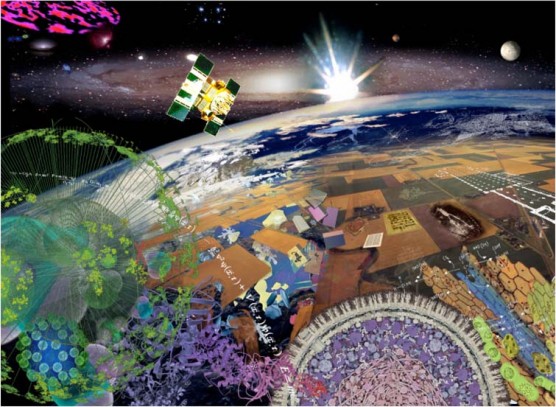
This artwork was created by Tom Rockwell under a commission of the Metanexus Institute. The goal was to represent the universe at all scales throughout time.
“We haven’t been a very exclusive species, with a very narrow origin,” said Martin Jacobsson. Interbreeding with other members of the human family tree “is not a unique event. It’s a more complex story than we thought before.”
In a new four-part television special based on his best-selling book, physicist Brian Greene takes on the nature of time and space, multiverses, and other hard-to-wrap-your-mind-around concepts in cosmology. Greene talks with guest host John Dankosky about the new series.