
What is the Metanexus?
“We are the music makers,
And we are the dreamers of dreams…”“Each age is a dream that is dying,
Or one that is coming to birth.”
Arthur O’Shaughnessy, in his great Ode, captured something uncannily like our moment: history does not move only through institutions, arguments, and systems. It also moves through imagination, desire, vision, and world-making. An age is not merely administered into being. It is dreamed, struggled through, broken apart, and born.
We are living at the end of such an age.
The strife, discontent, confusion, and shatteredness of our time are not incidental. They are not random surface disturbances on an otherwise stable order. They are signs of an era exhausting itself, the long death rattle of forms of life and thought that can no longer contain the world they helped produce. Old certainties fracture. Old binaries fail. Old institutions persist, but often as husks. What surrounds us now is not simply crisis. It is transition.
Transitions are dangerous. They are also creative.
Something new is trying to come into being. A new sensibility. A new metaphysics. A new way of understanding nature, culture, spirit, identity, technology, and human becoming. Not as separate provinces with guarded borders, but as interwoven movements within a living, unfinished reality. Not as fixed objects occasionally entering into relation, but as relation all the way down. Not as a world of static essences, but as a world of process, emergence, play, eros, complexity, adaptation, and transformation.
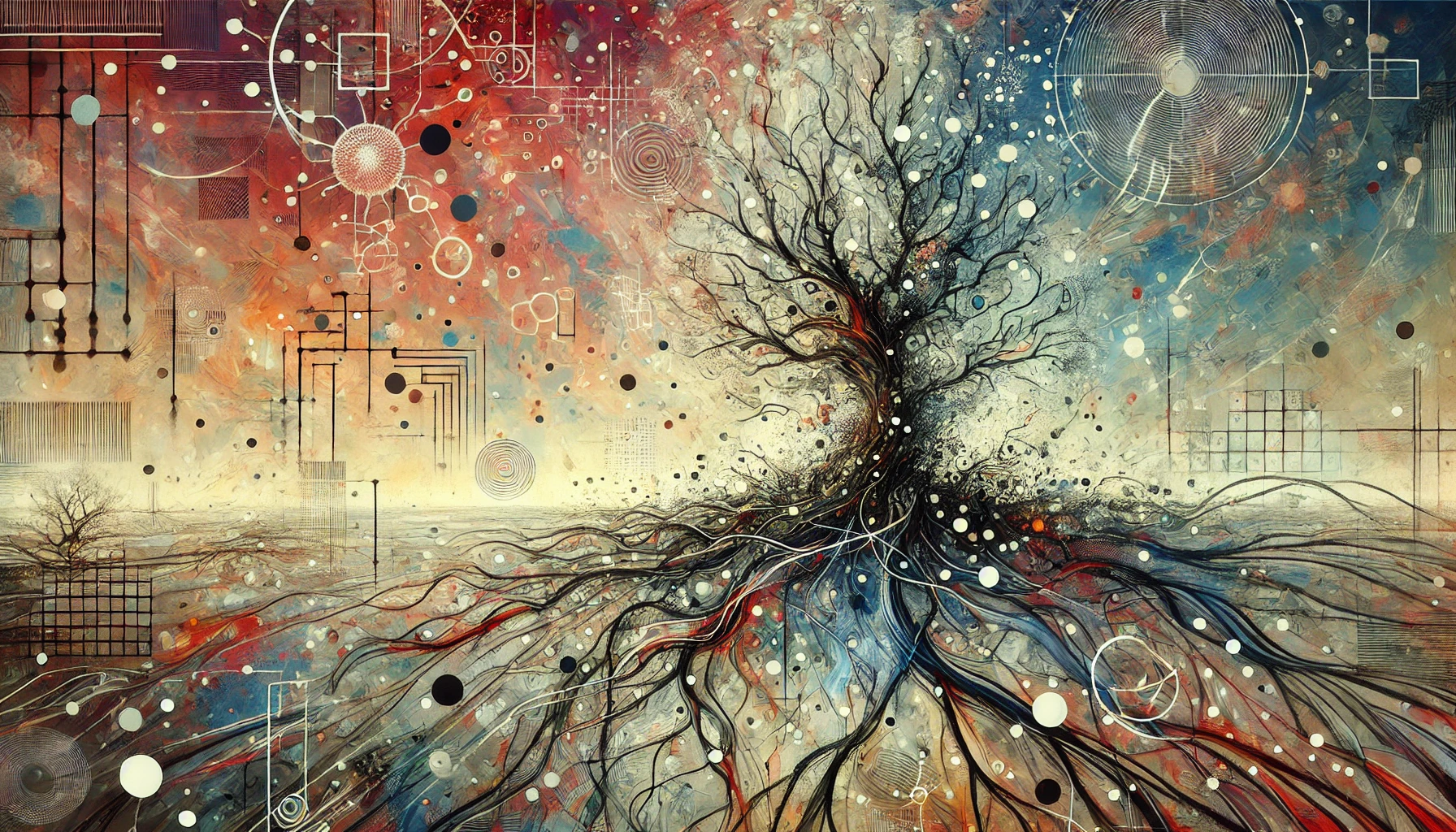
The Metanexus is not a bridge between separate things. It is the recognition that separateness was never the deepest truth in the first place.
What we call reality is not a stable inventory of objects occasionally entering into contact. It is an open field of relation, process, emergence, play, eros, adaptation, and transformation. Things do not simply connect. They arise through connection. More radically still, they arise through relations that are not merely mechanical but developmental, affective, technical, interpretive, and creative. The world is not composed of nodes that happen to form a network. It is network, relation, becoming, all the way down.
This is the Metanexus.
Derived from meta, meaning beyond, across, or through, and nexus, meaning connection, binding, or interweaving, the Metanexus names more than a junction. It names a generative field in which worlds meet and are transformed, where new forms of life and thought become possible, where the born and the made, the natural and the technical, the inherited and the self-fashioned, the spiritual and the material, all enter into a more complex and creative play.
Metanexus—this organization, the Metanexus Institute—has long stood at important crossings, especially in relation to science, religion, and the great human questions. That history remains part of its legacy. But the next life of Metanexus must be guided by a larger and more daring sense of what the Metanexus itself means. Not merely a site of dialogue between established domains, but a home for inquiry into an open, evolving, metamodern world.
That world calls for new intellectual and spiritual equipment. It calls for a vision shaped by complexity and evolution, by process thought and open-system dialectics, by infinite game theory and the spirituality of play, by a deeper account of technics and self-making, by constructive realism, by interiority and prehension, and by those forms of human life that most vividly reveal that becoming is more fundamental than conformity. It calls, in other words, for a renewed understanding of reality itself.
We are not merely inheritors of a world. We are participants in its ongoing composition.
We are, indeed, the music makers and the dreamers of dreams.
And if an old dream is dying, then the task is not merely to mourn it, nor to cling to its fragments, but to help midwife the one now coming to birth.
Welcome to the Metanexus.
Beyond dialogue toward becoming
At the turn of the millennium, one of the central intellectual and spiritual tasks of that late modern moment was to reopen a serious conversation between science and religion. That was real and necessary work. It resisted reductionism on one side and anti-intellectual retreat on the other. It insisted that the human search for meaning could not be neatly divided into separate rooms.
But the present moment asks more of us.
Today, it is not only the relationship between disciplines that is unstable. The categories themselves are shifting. Nature and culture no longer stand apart in any simple way. Technology is no longer just a tool outside the human, but one of the primary media through which the human remakes both world and self. Identity can no longer be imagined as a static inheritance untouched by interpretation, performance, desire, or design. Spirituality can no longer live on borrowed metaphysical assumptions from a closed cosmos. Even matter, mind, body, and meaning appear less like separate substances than like intertwined dimensions of an unfinished process.
This is why the next Metanexus must become more than a forum for dialogue. It must become a crossing-place for thinking becoming itself. The question now is not merely how two domains speak to one another. It is how reality unfolds through complexity, relation, tension, invention, adaptation, and transformation, and how human beings participate consciously in that unfolding.
Complexity and evolution: a universe still creating itself
Complexity and evolution belong near the center of this new orientation because they teach us to see that novelty is real.
Complexity science shows that the most significant realities are often emergent. They arise through interaction, feedback, recursive patterning, and self-organization. They cannot be reduced without remainder to the smallest parts out of which they arise. Life is not just chemistry rearranged. Mind is not just neural activity viewed from a different angle. Culture is not just a pile of individual choices. New levels of order appear, and those levels possess their own patterns, their own powers, their own forms of intelligibility.
Evolution deepens this insight by reminding us that the universe is not a fixed order populated by finished essences. It is a history of unfolding forms. It is a reality in which new capacities emerge over time, where responsiveness becomes sensation, sensation becomes perception, perception becomes thought, and thought becomes symbolic, technical, ethical, and spiritual world-making. Nature is not static. It is not simply a stage on which events occur. It is itself a drama of creation.
Once one sees the world this way, the older metaphysical mood begins to crack. Reality no longer appears as a closed machine. It begins to look more like a generative process, capable of producing forms not wholly deducible in advance from prior states. The human being, in this light, is not a stranger to nature, nor merely trapped inside it. Human making, imagination, ethics, ritual, art, technology, and love become extensions of a deeper evolutionary creativity.
For Metanexus, this is decisive. A platform adequate to our time must think in terms of emergence, development, adaptation, and layered intelligibility. It must understand the real not simply as what is, but as what is becoming.
Process thought and the primacy of relation
Process thought offers one of the clearest philosophical vocabularies for this world.
Instead of treating reality as fundamentally composed of inert substances, process thought understands the real as made of events, relations, inheritances, responses, and acts of becoming. The basic unit is not the thing sealed off from its world. The basic unit is the happening, the relational occurrence, the moment of reception and response. To be is to affect and be affected. To be is to inherit, interpret, and transform.
This changes everything.
It means relation is not an accidental property added to already-finished entities. Relation is constitutive. Process is constitutive. Becoming is constitutive. The world is not first a collection of separate objects and then, only later, a web. It is web from the beginning.
This matters because it offers a way beyond the exhausted opposition between reductive materialism and disembodied spiritualism. A processive metaphysics does not deny matter, but it refuses to treat matter as the whole story. It makes room for feeling, inwardness, valuation, desire, consciousness, and meaning as real developments within reality itself. It allows us to think the world as alive with depth without abandoning seriousness.
For Metanexus, process thought is not merely one school among others. It is one of the master keys. It provides a framework in which spirit is not alien to the cosmos, meaning is not a late and absurd accident, and the human person is not a machine hallucinating significance into an indifferent void.
Infinite game theory and the ethos of continuation
James Carse’s distinction between finite and infinite games belongs here not as a clever metaphor, but as a description of fundamentally different ways of inhabiting the world.
Finite games are played to win. They aim at terminal outcomes, fixed identities, stable roles, and clear victories. Infinite games are played so that the play may continue. They renew the field. They absorb surprise. They transform rules when necessary. They remain open to new participants, new possibilities, new futures.
A culture organized around finite-game logic becomes obsessed with control, certainty, possession, and closure. It polices boundaries compulsively. It fears ambiguity. It cannot tolerate emergence. It wants the world settled.
An infinite-game culture does not reject form or rigor. It rejects terminality. It understands truth and life not as trophies to be possessed once and for all, but as ongoing participations in a reality that remains richer than any current arrangement. It is disciplined without being closed. Serious without being rigid. Committed without being terminal.
This is one of the deepest ethical and institutional lessons for the next Metanexus. The point is not to win the argument between science and religion, or between secularism and spirituality, or between one moral anthropology and another. The point is to cultivate a living field of serious inquiry in which the play of thought, culture, and spirit can continue at a higher and more generative level.
Metamodernism and the return of daring sincerity
Metamodernism belongs within this vision because it names, however imperfectly, the cultural mood of living after both triumphalist modernity and ironic exhaustion.
We can no longer return innocently to the grand certainties that once organized the modern imagination. Too much has fractured. Too much has been unmasked. Too much has been revealed as partial, violent, exclusionary, or naïve. And yet we also cannot live forever within postmodern detachment, permanent suspicion, or cultivated fragmentation. Critique alone does not nourish a civilization. Irony alone cannot raise children, build institutions, restore meaning, or inspire sacrifice.
Metamodernism names the oscillation between hope and lucidity, sincerity and irony, reconstruction and critique, transcendence and immanence. It does not deny ambiguity. It refuses to be ruled by it. It seeks new forms of wholeness without pretending the fractures never occurred. It risks aspiration without surrendering intelligence.
That is why it matters here. The next Metanexus should not be modern in the old triumphalist sense, nor postmodern in the resigned or merely deconstructive sense. It should be metamodern in the stronger sense: willing to move between critique and construction, science and spirit, realism and imagination, complexity and devotion, without collapsing these tensions into cynicism on one side or sentimentality on the other.
Metamodernism, at its best, is not just an aesthetic mood. It is the cultural style of an open world trying to become conscious of itself again.
Play communities and spirituality as world-making
This is also why play deserves a place not at the margins, but near the center.
In thinkers like Bernard DeKoven, play is not the opposite of seriousness. It is one of seriousness’s most profound forms. Play generates trust, improvisation, experimentation, mutual transformation, and shared worlds. It allows persons and communities to discover possibilities that cannot be reached by control alone. It is not merely recreation. It is creation through relation.
This has enormous spiritual significance.
Too often spirituality has been framed in terms of obedience, repression, solemnity, or metaphysical certainty. But in a world understood as open, processive, and emergent, spirituality must also be understood as participatory. It is not only a matter of assenting to doctrines or preserving sacred forms. It is a matter of learning how to enter more consciously into the creative unfolding of life.
Ritual, contemplation, erotic life, friendship, artistic practice, communal experimentation, theological imagination, and forms of disciplined joy all contain this ludic dimension. They are not trivial. They are modes of participation in a reality that is itself generative.
The next Metanexus should therefore care not only about ideas in the abstract, but about play communities, spiritual practices, experimental forms of life, and the social conditions under which creative becoming can occur. A spirituality without play becomes brittle. A culture without play becomes cruel. An institution without play becomes dead before it knows it is dead.
Technology, technics, and the drama of the born and the made
Technology must be one of the main topoi of the new Metanexus because technology is no longer external to the human story. It is now one of its principal media.
We live at the unstable border between the born and the made. We inherit bodies, ecologies, drives, languages, kinship systems, and material constraints. But we are also creatures of technics. We make tools, symbols, institutions, media, architectures, algorithms, rituals, medicines, platforms, and prostheses. We transform environments, redesign habits, reshape perception, and increasingly intervene in the conditions of life itself. The human being is not simply born. The human being is also made, and self-made, through culture and technology.
This does not mean technology is opposed to nature in any simple sense. It may be more truthful to say that technics is one expression of nature’s own open-endedness. Nature produces creatures who do not merely adapt to environments, but remake them. Nature produces creatures who become artificial, symbolic, technical, and recursive. In that sense, the technical may not be an alien intrusion into the real. It may be one of the ways the real continues its own unfolding.
This is why Metanexus must engage technology not only instrumentally, as either blessing or threat, but metaphysically and spiritually. What does artificial intelligence reveal about mind, mediation, imitation, and creativity? What do biotechnologies reveal about embodiment, plasticity, and the limits of self-design? What do networks, platforms, and digital environments reveal about attention, desire, identity, and social reality? What happens when the human power to make folds back upon the human maker?
These are not secondary questions. They stand near the center of our civilizational transition.
Technology intensifies freedom, but also danger. It expands the human capacity to intervene, amplify, connect, and transform. But it can also feed abstraction, domination, alienation, surveillance, and the fantasy that making alone is enough. The next Metanexus must therefore refuse both technophobia and naïve technological triumphalism. It must ask how technics can be integrated into richer accounts of embodiment, ecology, meaning, and spiritual depth.
The future will not be shaped by nature alone or by technology alone, but by their recursive interplay. The deepest question is not whether the natural or the artificial will win, but what forms of life may emerge from their ongoing entanglement.
Identity, eros, and the courage of self-making
This is one reason LGBTQIA+ life, trans experience, polyamory, and sex positivity belong in this conversation not as fashionable additions, but as philosophically serious sites of inquiry.
They bring into sharp relief one of the defining questions of our age: what does it mean for human beings to participate consciously in their own becoming? If reality is open, evolutionary, processive, and technically mediated, then identity cannot be understood simply as obedience to a static blueprint. Nor can love and embodiment be confined without remainder to inherited scripts.
Trans experience, in particular, discloses with unusual intensity the truth that the person is not exhausted by prior classification. It reveals self-making as serious, embodied, costly, creative, and real. LGBTQIA+ life more broadly has expanded the field of visible possibility, showing that human dignity, love, kinship, beauty, and truth are not the monopoly of older compulsory forms.
Polyamory and sex positivity likewise force deeper questions into view. Not shallow libertinism, but the serious inquiry into whether intimacy, desire, plurality, freedom, honesty, and care can be composed in richer ways than inherited moral systems allowed. Even where one remains critical or cautious, the underlying philosophical field remains vital. How are persons formed through desire? What kinds of relational structures constrict life, and what kinds expand it? How do eros, ethics, and spirituality interpenetrate?
For the next Metanexus, the point is not to turn these questions into slogans or dogma. It is to recognize them as part of the larger inquiry into human becoming in an unfinished cosmos.
Constructive realism and the discipline of the real
None of this should be mistaken for a floaty refusal of limits. That is where constructive realism matters.
Reality pushes back. Bodies matter. Histories matter. Material conditions matter. Ecologies matter. Institutions matter. Not every desire becomes wisdom merely by being intense. Not every possibility becomes humane merely by being technically achievable. Not every act of self-fashioning becomes liberating merely by being chosen.
Constructive realism offers a discipline equal to vision. It allows for interpretation, plurality, imagination, and emergence while insisting that something real exceeds our preferences and resists our simplifications. It preserves seriousness without reducing reality to what a narrow materialism can measure. It keeps transcendence from becoming fantasy and freedom from becoming incoherence.
This discipline is indispensable. A Metanexus worthy of the name must be bold without becoming unserious, visionary without becoming vague, spiritually alive without becoming anti-intellectual. Constructive realism makes that possible. It keeps the project tethered to the world even as it opens the world more fully.
Interiority, prehension, and the depth of reality
This whole direction also depends on a renewed account of inwardness.
Modernity became extremely skilled at describing the exterior surfaces of things: mechanism, behavior, structure, function, system. What it often lost was a robust language for interiority. Yet consciousness, feeling, valuation, experience, and responsiveness are among the most undeniable aspects of existence. A worldview that cannot account for them is not especially hard-headed. It is incomplete.
This does not require a simplistic or cartoonish doctrine of panpsychism. But it does invite a recovery of the intuition, found in process thought and related traditions, that relation is not merely external and mechanical. There is prehension, reception, responsiveness, interiority, however differently distributed and differently intensified across the levels of reality. The world may have an inside as well as an outside.
That matters because a world with interiority is a world in which meaning is not absurdly accidental. It is a world in which mind, value, feeling, and spirit do not appear as late intrusions into a fundamentally dead cosmos. They appear instead as developments within a reality already marked by depth, relation, and responsiveness.
This vision strengthens the larger Metanexus project. It helps bridge science, philosophy, spirituality, and culture without collapsing any one into the others. It allows the human search for meaning to be cosmologically serious again.
The next Metanexus
So what should Metanexus now become?
It should become a home for thinking the open, evolving, technical, spiritual, erotic, and unfinished character of reality. A place where complexity, evolution, process, dialectic, metamodernism, play, technics, identity, eros, constructive realism, and interiority can be explored together without reduction and without dogma. A place where science, philosophy, spirituality, culture, and human futures meet not as frozen departments but as living currents within a larger inquiry.
This would not abandon the earlier Metanexus mission. It would fulfill it at a deeper level.
The science-and-religion conversation was always, at its best, about more than disciplinary diplomacy. It was about reality, meaning, and the human place in the whole. But the whole now appears more dynamic, more emergent, more relational, more technically mediated, and more unfinished than many inherited frameworks could comfortably hold. Our time therefore requires a broader and riskier imagination.
The next Metanexus should meet that moment.
Not as a museum of prior syntheses.
Not as a refuge for closed systems.
Not as a platform for tired binaries.
But as a living crossing-place for those who sense that reality is still becoming, that human beings are participants in that becoming, and that the deepest work of thought now lies at the interfaces: between nature and technics, spirit and embodiment, inheritance and invention, play and seriousness, truth and transformation, the born and the made.
That is what a “metanexus” should be now.
And that is where this next Metanexus begins.