Why the Higgs Boson Matters
From afar it may seem entirely disconnected from the real world, but the Higgs boson is much more integral to life, the universe and, well, everything than you may think.

From afar it may seem entirely disconnected from the real world, but the Higgs boson is much more integral to life, the universe and, well, everything than you may think.
The Wall Street Journal’s editorial board has long been understood to be not only antagonistic to the facts of climate science, but hostile. But in a remarkable example of their unabashed bias, they recently published an opinion piece that not only repeats many of the flawed and misleading arguments about climate science, but purports to…
Climate Innovation Centers can promote clean technologies but need backing with a coordinated effort
Over the next few months, chlorine will ensure that countless swimming pools don’t turn into microbe-choked petri dishes. That’s only one of many uses we’ve found for the element. We sprinkle it on our food as table salt — a k a sodium chloride. We pump water through pipes made of polyvinyl chloride. Perchlorate, a…
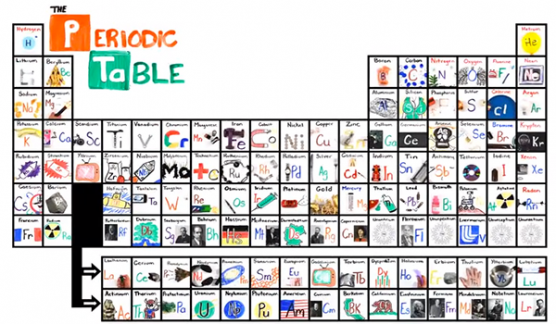
ASAP Science is an organization commited to helping you understand science in your own life. Their weekly videos cover “all sorts of quirky and mind blowing science.” Here, they have created a highly entertaining song and cartoon to guide you through the periodic table. Written, Directed, Produced, Edited and Sung by Mitchell Moffit. Based on…
A new study indicates that the last interglacial period may give us a picture of where the planet is headed now, as greenhouse gases increase and temperatures rise. Results from the NEEM deep ice core drilling project, led by the University of Copenhagen, show that during the Eemian period, between 130,000 and 115,000 years ago,…
From Massimo Pigliucci’s Rationally Speaking blog: Here is an interesting statistic: if we multiply the (approximate) number of computers currently present on planet Earth by the (approximate) number of transistors contained in those computers we get 10^18, which is three orders of magnitude larger than the number of synapses in a typical human brain. Which…