Thermal Society
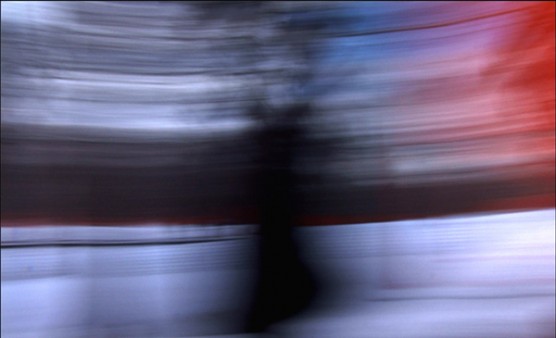
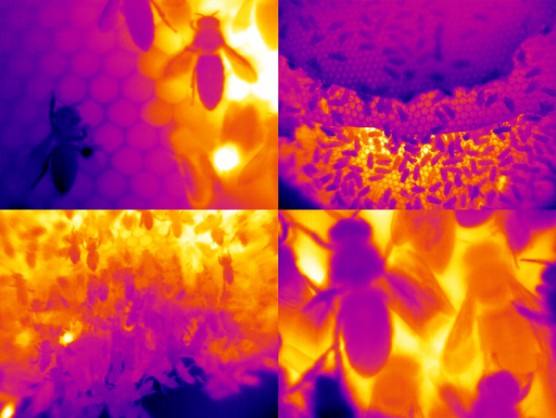
A bustling society is difficult to visualize in its entirety, even when peering through the transparent window of an observation hive full of honeybees. Some individual behaviors and collective actions are impossible to perceive with the naked eye. To overcome this obstacle, I recently recorded and mapped behaviors of bees using infrared imaging technology. During the course of my scientific research in a German apiary—the BEEgroup at the University of Würzburg—I filmed colonies of honeybees and created thermal visions in which temperature translated into color, and patterns of activity emerged. My thermal portraits feature bees performing waggle dances (communicating direction and distance of desirable destinations to sisters), heating brood, thermally slaughtering invaders, and sleeping. These portraits are an attempt to capture the invisible actions of a society.
The work consists of raw data I am analyzing in my research efforts, as well as a range of snapshots of less relevant behaviors to round out the thermal activities of a honeybee colony. This video is meant to visually tell a natural history story from a composite of clips, as well as highlight the research I am conducting and excite an audience, guided to look at honeybee activities with a new eye.
I modified observation hives in novel ways in order to capture a society’s response to invasion (by wasps), and to highlight behaviors otherwise difficult to discern with the naked eye. Thermal imagery makes the invisible visible by clearly displaying the thermal output of subjects. The palette of colors I selected, interspersed with ROYGBIV still photographs, visually demonstrates the mortally devastating impacts of honeybees’ defense against invading wasps.
Barrett Klein creates art driven by biological concepts, and his science—a combination of investigating sleep in societies of insects, and collaboratively exploring communication in frogs fooled by robot doppelgangers—is enhanced by visuals. He works with honeybees to figure out how sleep operates in colonies, and why it might be of specific benefit to its different members, and he has recently begun to image the active brains of sleeping honeybees, extending his reach to visualize subjects with the help of Lisa Rath, Christoph Kleineidam, and Giovanni Galizia at the University of Konstanz, Germany. In his new role as a professor of animal behavior at the at the University of Wisconsin–La Crosse, he will to juggle and join aspects of biology, scientific visualization, cultural entomology, and art.