Bohemian Gravity
Delighted to share this video of String Theory set to Bohemian Rapsody by A Capella Science. This video and two others are the work of Timothy Blaise, a graduate student in theorectical physics at McGill University. Enjoy!

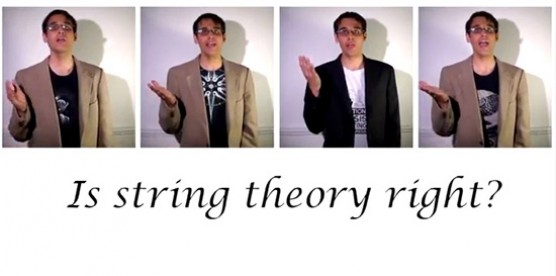
Delighted to share this video of String Theory set to Bohemian Rapsody by A Capella Science. This video and two others are the work of Timothy Blaise, a graduate student in theorectical physics at McGill University. Enjoy!
One of the most remarkable discoveries about exoplanets—planets that exist outside of our solar system—is that some of them appear to be flying through interstellar space on their own. They’re not orbiting a star, nor are they tied to any other obvious companion. The precise number of these planets—alternately called “free-floating,” “Steppenwolf,” “unbound,” or “rogue”…
Andy Murray’s unexpectedly strong start against Roger Federer in the Wimbledon 2012 final put the Daily Telegraph columnist Matthew Norman in a science-fiction mood. ‘It seemed we’d been transported to one of those parallel universes into which Doctor Who likes to slip with insouciant ease,’ he commented. A year later, that alternative world became reality,…
This time, they say, Einstein might really be wrong. A high-octane debate has broken out among the world’s physicists about what would happen if you jumped into a black hole, a fearsome gravitational monster that can swallow matter, energy and even light. You would die, of course, but how? Crushed smaller than a dust mote…
Until quite recently we knew of only one life-harbouring planet in a single planetary system — adrift within a universe of more than a billion trillion stars. Our home was that single speck, the lone bulb in a great cosmic garden, and it raised essentially the same question: is this all? Or are there more?…
Something big is about to happen on the sun. According to measurements from NASA-supported observatories, the sun’s vast magnetic field is about to flip. “It looks like we’re no more than 3 to 4 months away from a complete field reversal,” says solar physicist Todd Hoeksema of Stanford University. “This change will have ripple effects…
If physicists had a holy grail it would go by the name of Quantum Gravity. For 60 years researchers have been searching for a way to unite the very large and the very small into a single coherent theory. But for all their efforts, Einstein’s Theory of General Relativity — which describes the Universe at…
The notion of the speed of light as the cosmic speed limit is based on the assumption that particles of light, called photons, have no mass. But astrophysical observations cannot rule out the slim chance that photons do have a tiny bit of mass—a prospect with wide ramifications in physics. For instance, if photons weigh…
It started with a bang, and has been expanding ever since. For nearly a century, this has been the standard view of the Universe. Now one cosmologist is proposing a radically different interpretation of events — in which the Universe is not expanding at all. In a paper posted on the arXiv preprint server1, Christof…
The Gruber Foundation, a Type 1 supporting organization operated and supervised by Yale University, has announced the recipients of the 2013 Gruber Cosmology Prize, which recognizes theoretical, analytical, conceptual, or observational discoveries leading to fundamental advances in our understanding of the universe.
The $500,000 prize was awarded to Viatcheslav Mukhanov, professor of physics at the Ludwig-Maximilians-Universität in Munich, and Alexei Starobinsky of the Landau Institute for Theoretical Physics in Moscow for their formative contributions to inflationary theory, an essential component for understanding the evolution and structure of the universe. Mukhanov’s and Starobinsky’s contributions to inflationary cosmology have provided compelling answers to essential cosmological questions and validated a key prediction of Big Bang theory.